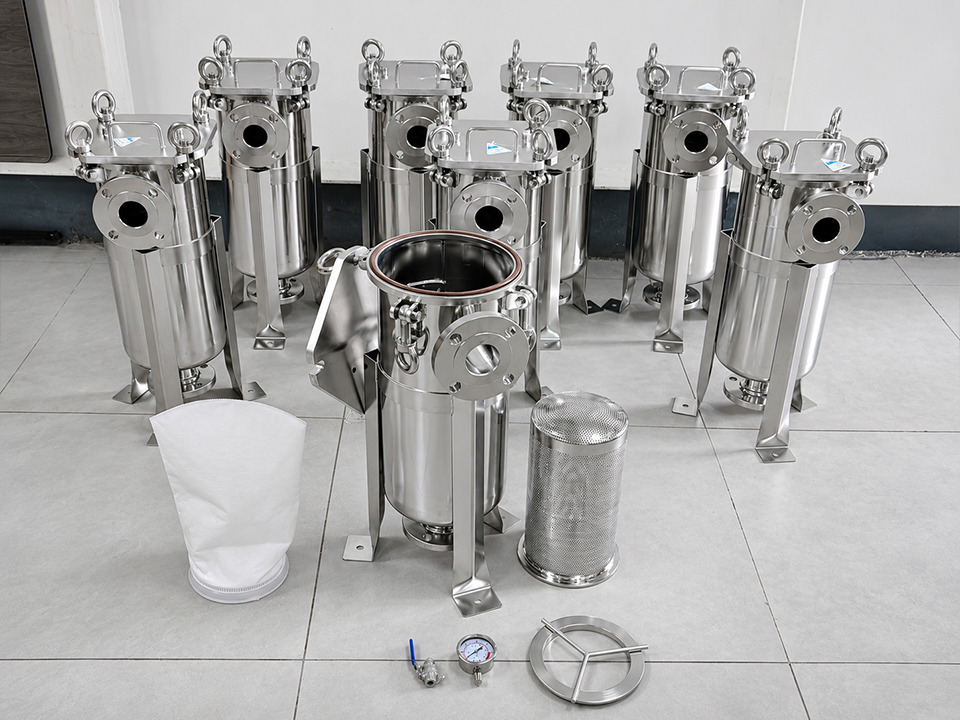
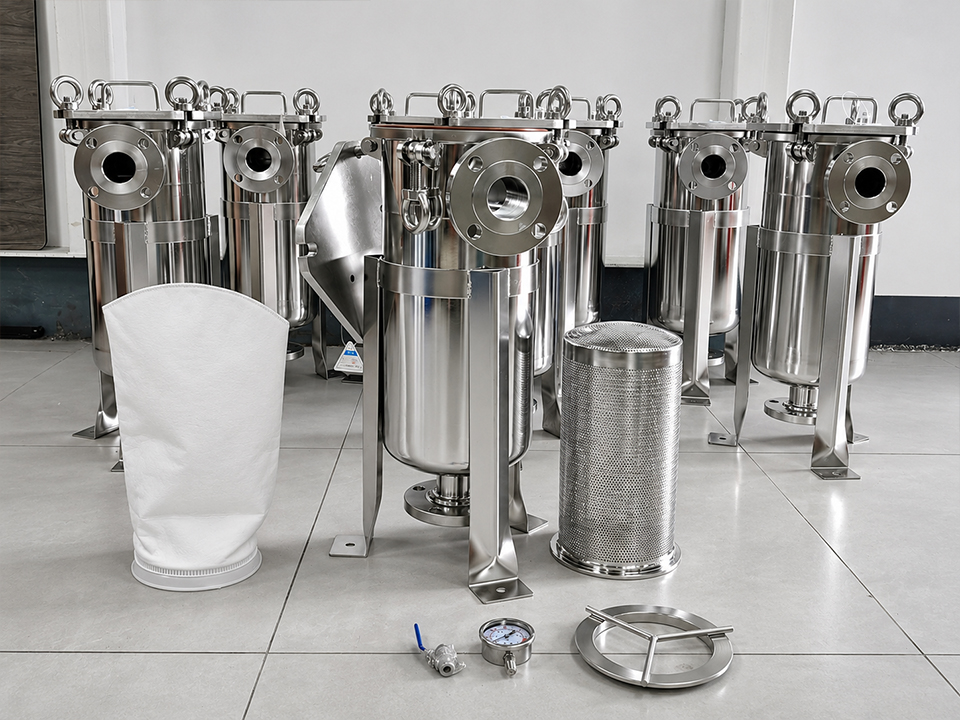
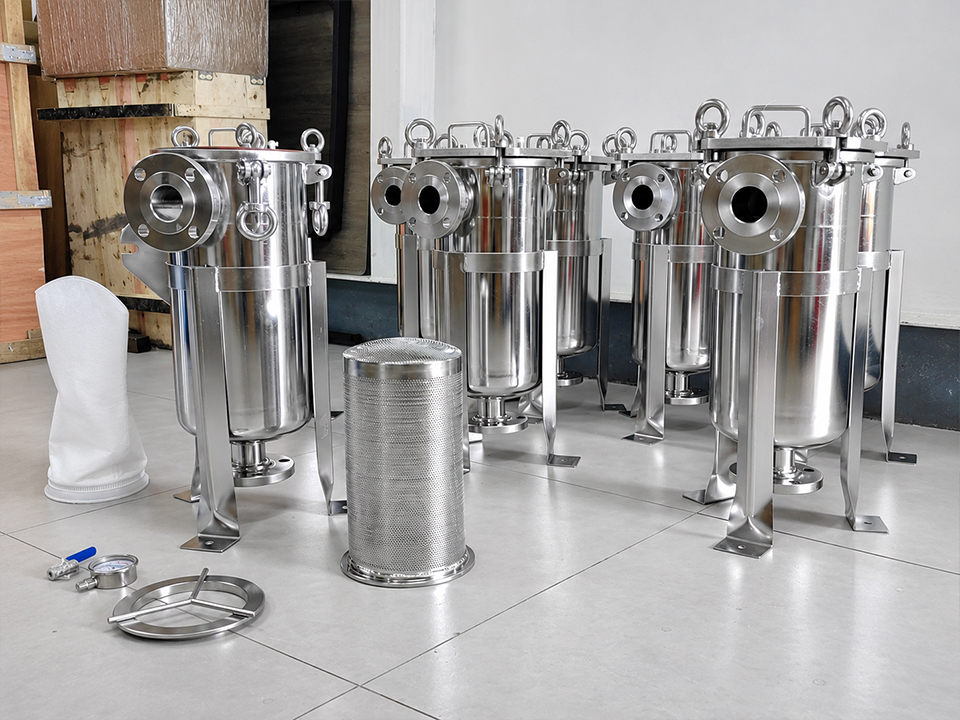
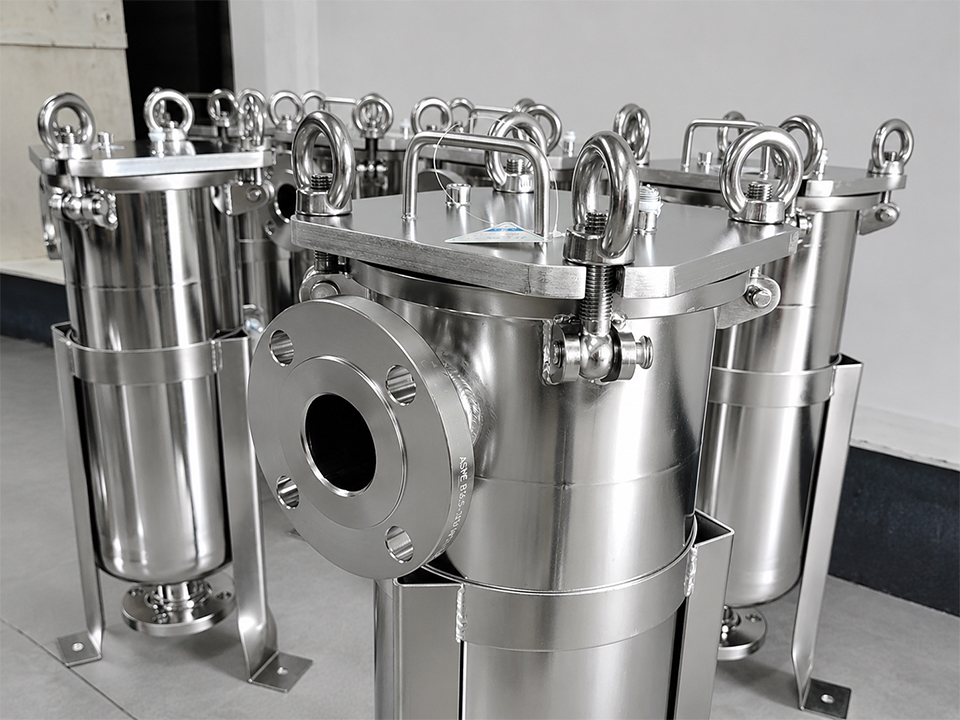
Guangzhou Lvyuan Su Arıtma Equipment Co, Ltd, 2009 yılında kurulan ve paslanmaz çelik filtre muhafazaları, paslanmaz çelik steril su tankları, filtre elemanları, filtre torbaları, ultra polimer malzemeler ve sinterlenmiş filtre ürünleri tasarlayan ve üreten endüstriyel bir filtre üreticisidir. Alıcılar OEM/ODM desteği, ISO9001 kalite kontrolü ve çok ülkeli sertifikalar için Lvyuan'ı seçmektedir.
Belediye ve Endüstriyel Su Sistemleri için Filtre Muhafazası Tasarımı
A filter housing on a water skid is a pressure-containing component, a maintenance point, and a piping fitting at the same time. If it is specified only by cartridge size and micron rating, the problems usually appear after commissioning: an operator cannot pull a 40-inch cartridge because of headroom, a clamp gasket is wrong for the cleaning chemistry, or the housing’s rated pressure sits above what the cartridge and seals can actually survive. This guide explains how to design or specify filter housings for skid-mounted municipal and industrial water treatment, covering housing type, sizing logic, materials, connections, pressure limits, instrumentation, serviceability, and the data a manufacturer needs to quote accurately. It is written for engineers, procurement teams, and skid builders who need to turn a process duty into a housing specification.
What Does Good Filter Housing Design Mean on a Skid?
Good filter housing design means the housing, its internal element, and its connections are matched to the process duty, the skid layout, and the plant’s maintenance routine. The housing is not judged in isolation. It is judged by how it behaves in service over many element change-outs.
Five questions define the design problem:
What is being filtered: raw water, potable water, RO feed, process liquid, or a gas line.
What the filter is protecting. Pumps and meters need coarse protection, while RO membranes, UV reactors, and sanitary processes need defined cartridge-level retention.
What the real operating limits are, including cleaning chemistry.
How often, and by whom, the housing will be opened.
Which regulations or customer specifications apply.
For water that reaches consumers, material compliance deserves early attention. NSF/ANSI 61 is an American National Standard that sets minimum health-effects requirements for chemical contaminants imparted to drinking water by system components, and its scope lists valves, filters, gaskets, and sealing materials. NSF notes that it does not set performance, taste and odor, or microbial growth requirements. So an NSF/ANSI 61 certificate says something about leachables from specific materials. It says nothing about pressure rating, filtration efficiency, or mechanical suitability, and the certificate belongs to a specific product model, not to a supplier in general. The standard is revised periodically, and ANSI’s overview of the 2025 edition shows a newer text than the 2016 version NSF publishes for free, so ask which edition a certificate refers to. The Lvyuan product pages inspected for this article do not list NSF/ANSI 61 for the models discussed, so a potable-water project should request model-specific documentation before assuming compliance.
Which Housing Configuration Fits Which Skid Role?
The first design decision is configuration, because it fixes the footprint, the maintenance method, and the filtration range. The table below compares the main options. Ratings in the right-hand column are the values published on the manufacturer’s own product pages. They are a reference range, not a guarantee for any particular build.
Yapılandırma
Typical skid role
Main design advantage
Temel sınırlama
Published reference range (Lvyuan product pages)
Y-type basket strainer
Coarse protection ahead of pumps, valves, meters
Basket can be cleaned through a cover without dismantling the pipeline
Coarse retention only; not a substitute for cartridge filtration
50–300 μm; up to 10 bar; up to 120°C
Çift katlı sepet gövdesi
Coarse prefiltration where flow cannot stop
One chamber isolated for cleaning while the other stays in service
Valve sequence must be followed; larger footprint
100–1,000 μm; up to 6 bar; up to 100°C
Single-cartridge sanitary or inline housing
Polishing or protection filter on small to mid-size lines
Simple, cheap to replace, easy to standardize
Flow limited by one element; frequent change-outs at high solids load
More filter area in one vessel; fewer pipe connections
Heavier lid, more O-ring sealing points, bigger lifting task
3–12 cartridges; up to 10 bar; up to 150°C
Flanged sintered-metal housing
Steam, gas, or liquid duty needing a cleanable rigid element
Flanged ports and bolted cover suit pipeline integration
Rating depends on element and flange class; verify case by case
Rating not published on the page
Mobil filtreleme arabası
Commissioning, flushing, pilot trials, temporary polishing
Pump, housings, valves, and gauges on one frame
Not a substitute for a fixed skid design
0.2–100 μm; 5–50 GPM; up to 6 bar; up to 80°C
Two points matter more than the table suggests. First, the pressure and temperature values listed for a housing are the housing’s limits. The cartridge, the O-ring material, and any closure clamp may allow less. The multi-cartridge page itself notes that allowable conditions depend on the selected cartridge and sealing material, which is the correct way to read every housing rating.
Second, “municipal” and “industrial” skids often use the same housings but different surrounding practices. A municipal pre-treatment skid may prioritize low pressure drop, long run times, and plant-wide spares standardization. A pharmaceutical or beverage utility skid may prioritize polished surfaces, drainability, and clamp connections. The housing is similar, but the specification around it is not.
How to Size a Filter Housing for Flow and Pressure Drop
Housing size follows from flow, the element’s flow capacity at the required retention, and the pressure drop the system can tolerate. There is no universal flow-per-cartridge number. The figure depends on media type, pore rating, fluid viscosity, and how dirty the water is.
A workable sizing sequence looks like this:
Start with design flow, not average flow. Use the peak flow the pump can deliver, including any future capacity increase the skid is meant to accommodate.
Set a pressure-drop budget. The housing should leave room for a clean-element pressure drop and a rise to the point where the element manufacturer says to replace it. That terminal value belongs to the cartridge supplier, not to the housing manufacturer.
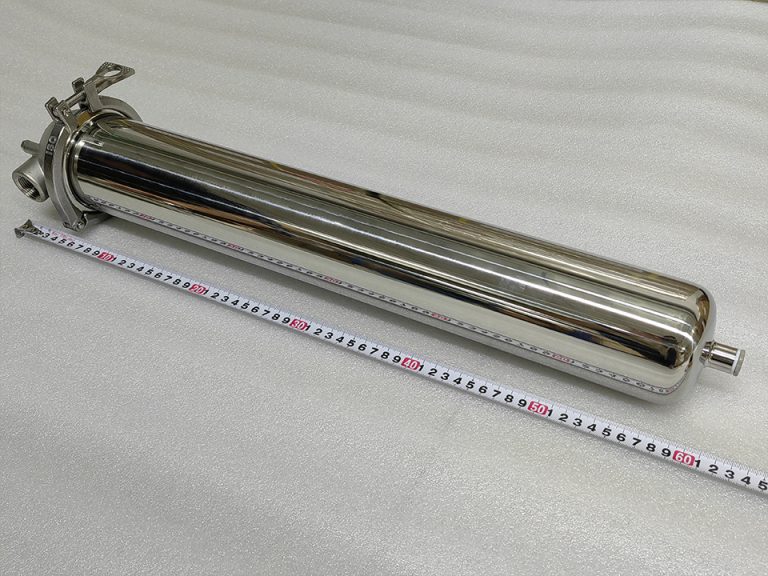
Match element count to flow. One single-cartridge paslanmaz çelik inline filtre muhafazası is listed at up to 6 m³/h, so a skid with higher flow needs either parallel single-housing trains or a multi-cartridge vessel.
Check line velocity at ports. Small ports on a large housing create local velocity and unnecessary pressure drop that no cartridge choice can fix.
Plan for the dirty case. Size for the water you will have in a bad season, not the one measured on a clear day.
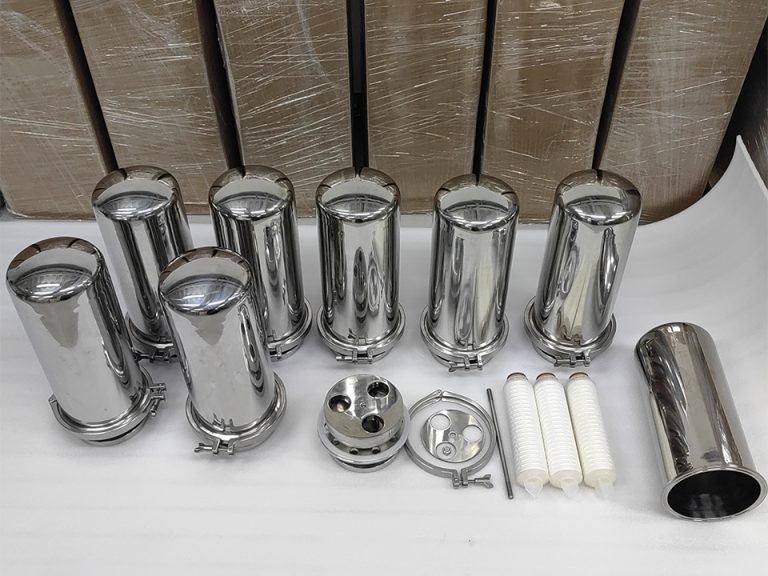
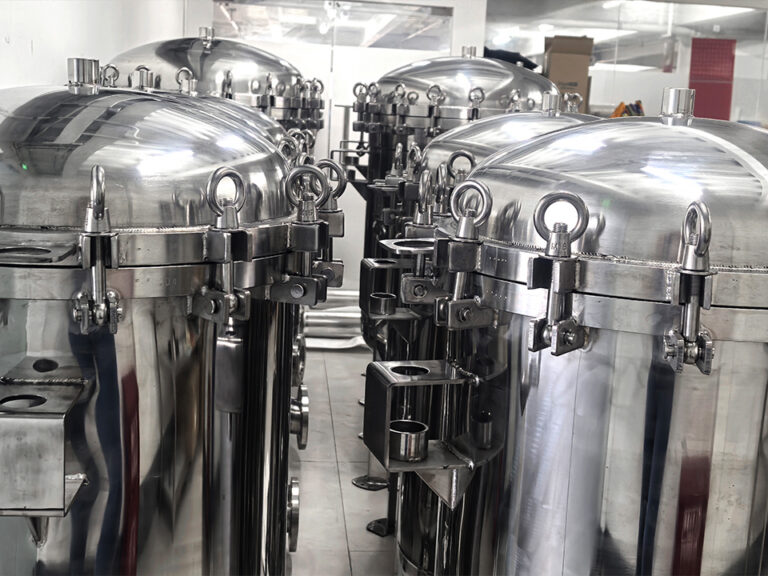
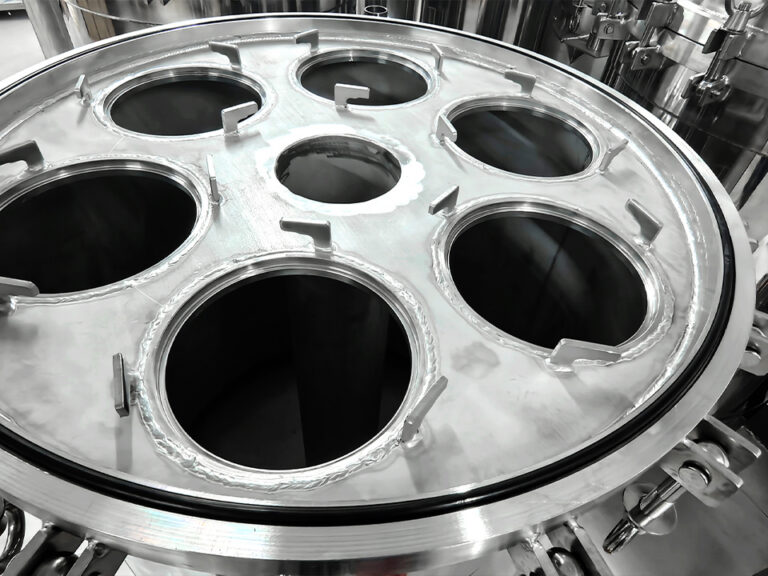
For skids that must hold a steady output between change-outs, the hijyenik çok kartuşlu yuva format puts 3–12 cartridges in one vessel. That raises filter area while cutting the number of piping connections. The trade-off is handling: a lid that covers several elements is heavier, has more sealing interfaces, and may need a lifting aid.
Fix the cartridge end style early. DOE, 222, and 226 ends are not interchangeable, and a housing is built for one seal style, so the choice locks the skid to a cartridge family. Across a fleet of skids, standardizing on one end style and a few lengths reduces spare-part variety. That often matters more to an operator than a small difference in unit price.
Materials, Finish, and Seals: What Actually Drives Corrosion Risk
Stainless steel grade is usually the first material question, and the product pages in this category list SS304 and SS316L. Choosing between them is a corrosion question, not a quality ranking.
Chloride level. Chloride attacks the passive layer on stainless steel. Higher chloride, higher temperature, and stagnant conditions raise risk. SS316L has molybdenum and generally tolerates chloride better than SS304, but it is not immune. Seawater or hot brine duty often calls for a materials engineer’s review rather than a default grade choice.
Crevices and stagnation. Gasket seats, clamp joints, and dead legs are where localized corrosion tends to begin. A skid left idle and filled with water between runs is a different corrosion environment from one in continuous flow.
Cleaning and disinfection chemistry. Chlorine-based sanitizers, acids, and caustic cleaners each affect stainless steel and elastomers differently. List them in the specification.
Weld quality and finish. Surface finish affects cleanability. Mirror polish and electropolish are options on the inspected pages. Whether you need them depends on the process.
Seal material is a separate decision. The inline housing page lists silicone, EPDM, and FKM options. EPDM is generally associated with water and many cleaning chemicals, FKM with some hydrocarbons and higher-temperature chemical duty, and silicone with certain hygienic uses. Compatibility depends on the exact fluid, temperature, and cleaning agent, so confirm it against the supplier’s chemical resistance data. For potable duty, ask for evidence that the elastomer itself is covered by the applicable drinking-water material requirement.
Is a Polished Sanitary Housing Necessary for Water Treatment?
Not always. Polish and clamp connections add cost and buy cleanability and drainability, which matter in food, beverage, pharmaceutical, and some ultrapure water services. On a general raw-water or cooling-water skid, flanged connections and a plainer finish may give a lower total cost of ownership. The opposite error also happens: buying the cheapest housing where biofilm control or CIP is a requirement. Specify finish and connection type from the duty, not from habit.
Choosing Connections: Tri-Clamp, Flanged, or Threaded
Connections define how fast the housing can be installed or removed and how much load it can carry from the piping.
Bağlantı
Where it fits
Watch for
Sanitary tri-clamp
Hygienic skids, frequent disconnection, small to mid line sizes
Clamp and gasket rating limit the joint, not only the housing; confirm both
Flange standard and pressure class must match the pipe (for example DN or ANSI series); bolt access
Threaded
Small lines, instrument and drain ports, compact carts
Sealing and repeated disassembly wear; not preferred for frequent opening
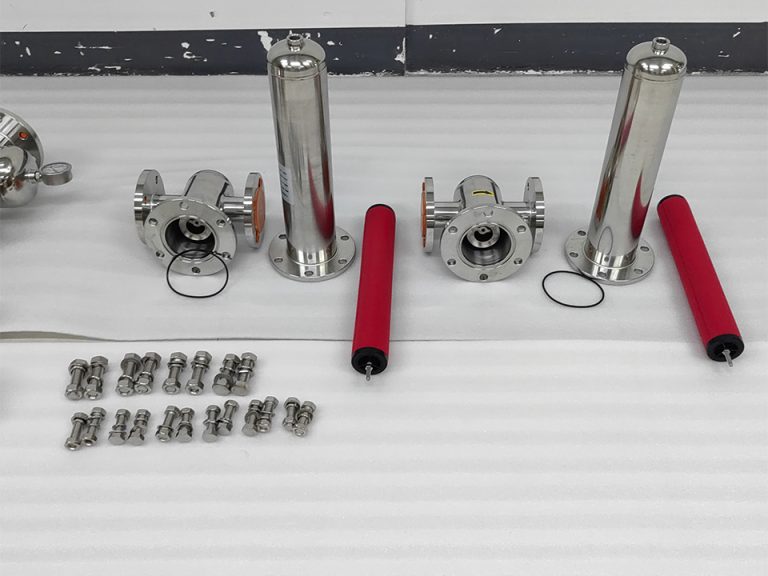
A flanşlı sinterlenmiş kartuş filtre gövdesi is an example of a design where flanged ports and a bolted cover suit industrial pipelines and a rigid, cleanable sintered metal element. Its product page does not publish a pressure or temperature rating. A buyer should request the design pressure, temperature, flange standard, and element details in writing before treating it as suitable for steam or high-temperature service.
At the other end of the range, the paslanmaz çelik sıhhi kartuş filtre gövdesi uses clamp inlet and outlet connections, a clamp-band quick-opening closure, a top pressure gauge, and a vent port. That arrangement favors fast element change on a hygienic line over high-pressure pipeline duty.
Instrumentation, Venting, and Maintenance Access
Many field complaints about housings are really skid-layout complaints. These details cost little at the design stage and are expensive to retrofit.
Differential pressure measurement. Fit gauges or transmitters upstream and downstream, or a differential gauge across the housing. Without them, operators change cartridges on a calendar rather than on condition.
Vent and drain. The top vent lets air leave when filling. Air trapped in a housing can create pressure spikes and uneven wetting of the element. A drain lets the vessel be emptied before opening, so the cartridge is not lifted out full of liquid.
Isolation and bypass. Isolation valves on both sides allow safe servicing. A bypass can keep a skid running but removes protection, so decide whether that is acceptable for the duty.
Headroom and drop-out clearance. To remove a cartridge, you need clearance at least equal to its length plus handling space. A 40-inch element in a low enclosure is a recurring design oversight.
Pipe loads. Housings should not carry piping weight or thermal expansion loads unless the supplier has designed for it.
When Does a Duplex Arrangement Make Sense?
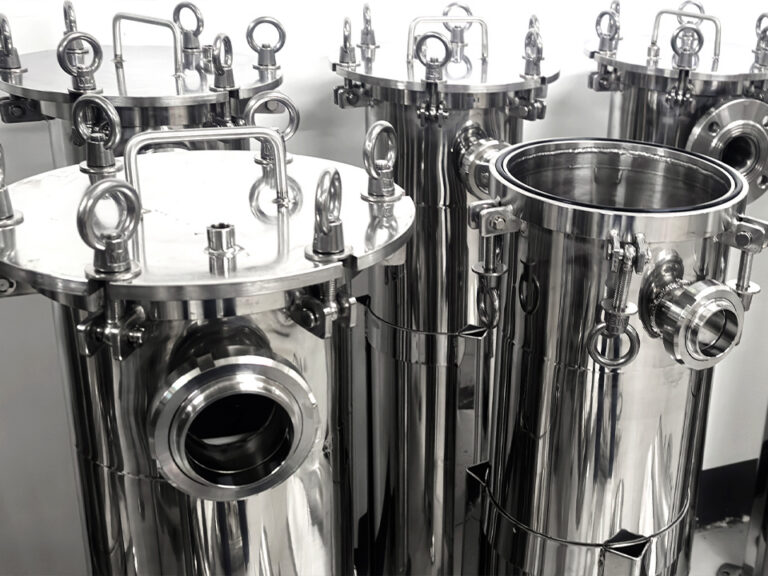
Use a duplex when stopping flow to change a filter is unacceptable or costly. The sanitary duplex filter housing system has two basket chambers with manual isolation valves, so one chamber can be isolated and cleaned while the other continues to filter. It is listed for coarse filtration of 100–1,000 μm, which makes it a prefiltration device, not a polishing stage.
A duplex adds valves, welds, and a procedure. Operators need to fill and vent the standby chamber before switching, otherwise air or a pressure surge enters the line. Manual valves also depend on training. If the process can tolerate a short planned shutdown, a single housing with a bypass or a spare skid may be the more economical design. Pay for duplexing only when the cost of stopping flow justifies it.
Where Do Strainers Belong?
Strainers and cartridge housings do different jobs. A sıhhi paslanmaz çelik Y süzgeç uses a removable perforated basket to catch solids ahead of pumps, valves, and meters, and its page lists 50–300 μm ratings. Putting a strainer ahead of a cartridge housing can extend cartridge life by removing larger solids. It does not replace the cartridge stage, because baskets are too coarse for most downstream protection duties.
Gas Lines and Temporary Filtration on the Same Skid
Water skids are often not water-only. Instrument air for actuated valves, nitrogen for tank blanketing, or process gas lines may share the same frame. A gas filter has different design needs: gas-compatible seals, different pressure behavior, and in some cases sterile-grade elements. The T tipi paslanmaz çelik gaz filtresi gövdesi is listed for compressed air, nitrogen, and compatible process gases, with 10–40 inch cartridges, DN25–DN80 ports, up to 10 bar and 150°C. Do not substitute a liquid housing for a gas line without the supplier confirming the pressure rating and seal material for gas service.
For commissioning and troubleshooting, a taşınabilir paslanmaz çelik filtreleme arabası combines housings, a centrifugal pump, valves, and pressure instruments on a wheeled frame. It can flush new piping, polish a batch, or run a pilot trial with different cartridge media before the fixed skid is finalized. Its published limits are lower than those of the fixed housings above (6 bar and 80°C), so treat it as a service tool rather than a permanent design.
Yaygın Şartname Hataları
Specifying micron rating without defining how it is measured. Nominal and absolute ratings behave differently, and the rating belongs to the cartridge, not the housing.
Using the housing’s maximum pressure as the operating limit. The weakest component in the assembly sets the limit.
Ignoring cleaning chemistry and thermal sanitization. These are often the real temperature limit for elastomers.
Skipping the question of pressure equipment rules. Whether a housing falls under a code or directive depends on pressure, volume, fluid, and jurisdiction. Ask the supplier which design code and documentation apply to the exact model.
Choosing the finest cartridge available. A finer rating raises pressure drop and shortens run time. It can increase total cost when the downstream process does not need that retention.
Letting unit price lead. A cheaper housing with awkward access, non-standard cartridge ends, or unavailable seals can cost more across several change-out cycles.
An illustrative scenario (hypothetical, not a customer case): a skid builder fits a single 0.2 μm cartridge to protect a sensitive downstream process, and run time collapses on turbid feed. Adding a coarse strainer and a coarser prefilter ahead of the polishing stage may let the final element last longer. The actual benefit depends on particle load and size distribution, which a bench trial can measure.
Alıcılar, fiyat teklifi talep etmeden önce neleri belirtmelidir?
A manufacturer can only quote accurately if the process and layout data are complete. Send the following with the RFQ:
Information
Neden önemli
Fluid, including chloride level, pH, and disinfectant
Sets stainless grade and seal material
Design flow and pressure-drop limit
Sets housing size and element count
Design pressure and temperature, including upset and cleaning conditions
Sets rating and code route
Required filtration rating and cartridge type
Sets element, end style (DOE, 222, 226), and length
Connection type, size, and pipe standard
Prevents adapter and flange mismatches
Finish and cleanability requirement
Determines polish and drainability
Certification and documentation needs, including potable-water material evidence
Order quantity, spare-parts scope, and delivery schedule
Affects pricing and OEM planning
Sample or prototype requirement
Reduces risk before volume order
When you issue the request, ask each supplier for the same set of answers: the design pressure and temperature of the exact model, the seal material, the connection standard, the weld and surface-finish method, the inspection and pressure-test practice, and the certificates that apply to your market. Compare those answers before comparing price. Lvyuan, the manufacturer behind the products referenced here, states that it supports OEM/ODM projects. As with any supplier, confirm lead time, minimum order quantity, and certification scope in writing for your specific model.
Sıkça Sorulan Sorular
What is the difference between a filter housing and a strainer on a water skid?
A strainer uses a coarse perforated basket to catch larger solids and protect pumps, valves, and meters. A cartridge filter housing holds a finer replaceable element for defined retention. Many skids use a strainer upstream of a cartridge stage to extend element life.
Is SS316L always better than SS304 for water treatment housings?
No. SS316L generally resists chloride corrosion better, but the right choice depends on chloride level, temperature, stagnation, and cleaning chemicals. SS304 can be adequate in low-chloride service. High-chloride or hot brine duty should be reviewed by a materials engineer.
How do I choose between a single-cartridge and a multi-cartridge housing?
Choose by flow and maintenance routine. A single housing suits lower flow and simple standardization. A multi-cartridge housing provides more filter area in one vessel for higher flow, but the lid is heavier and it has more seal points to inspect at each change-out.
Do filter housings need NSF/ANSI 61 certification?
Only where the housing contacts drinking water and local rules or customer specifications require it. The standard covers health effects of materials in contact with drinking water, not performance. Ask for a certificate that names the exact model and materials.
When should I specify a duplex filter housing?
Specify a duplex when stopping flow to clean or change elements is unacceptable. One chamber stays in service while the other is isolated. If a short planned shutdown is acceptable, a single housing with a bypass may cost less and be simpler to operate.
What information does a manufacturer need to quote a skid filter housing?
Provide fluid and chemistry, design flow, pressure and temperature (including cleaning conditions), cartridge type and rating, connection size and standard, finish, certification needs, skid clearances, and quantity. Incomplete data leads to re-quotes, wrong seals, or interface mismatches.
Can a mobile filtration cart replace a fixed filter housing on a skid?
Generally no. A cart suits flushing, commissioning, batch polishing, and pilot trials. A permanent skid housing is designed around the line’s flow, pressure, and maintenance access, and typically has higher continuous-service ratings than the cart’s listed limits.